
Tehran–South and Back Again
Or: Fate doesn't knock. It writes a letter. And someone else has to pack.
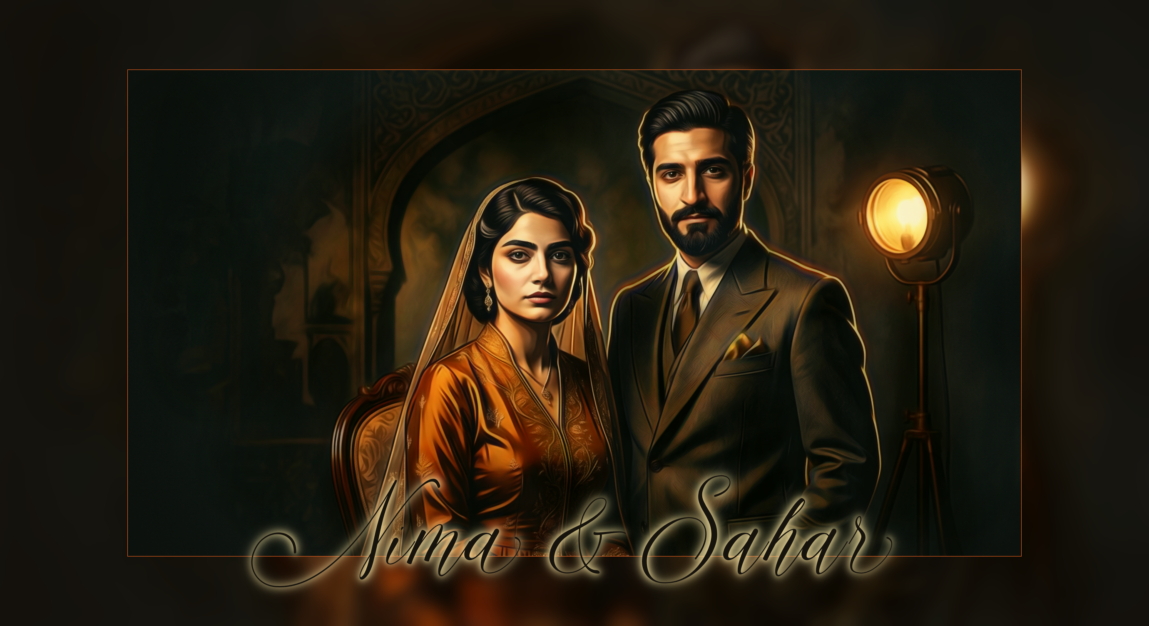
Chapter 1: A Photograph Against Forgetting
Tehran makes room for the future – or at least for a souvenir photo.
The year is 1930. Nima and Sahar—a young, happy Persian couple wrapped in a millennia-old tradition that is currently being gently, yet inevitably, embraced by modernity.
Tehran in 1930 breathes transition. The old mud brick city walls have only recently been torn down to make room for wide, European-inspired avenues like the famous Lalezar. On the boulevards, life changes pace by the second: elegant, sputtering automobiles from Europe and the first motorized buses honk their way past traditional donkey carts and horse-drawn carriages.
It is a clash of eras. One sees men in traditional robes wearing the newly decreed Pahlavi cap, a dark peaked hat. Women move in a fluid transition—some in classical Persian attire, while in the wealthier districts, the first women courageously wear French fashion and fine hats. There is a palpable, almost electric energy of change in the air.
And it is precisely this change that has brought photography to Tehran.
We stood in the photographer's studio, the air thick with the scent of developing chemicals, heavy velvet curtains, and a touch of nervous excitement. A photograph was a precious thing in those days. It captured a rare, enduring moment of love and togetherness. In a time when photography was still a rare event and not a fleeting part of daily life, such an image proved modernity, prosperity, and the deep desire for a shared life. A portrait was deliberately staged, a solemn act, not just a casual snapshot.
That is why this image feels not only aesthetic today, but like a small, shining testament to hope and happiness. For Nima and Sahar, it radiates dignity, makes their closeness visible, and preserves a quiet moment for the future.
To be honest, the two of them had no time for sentimentality; after all, the suitcases were already packed. But who knew when they would look into the lens of a camera again? So they had asked the master behind the wooden tripod to capture this fleeting moment.
The camera clicked. For a tenth of a second, time stood still.
Now we had the proof in black and white right in our pockets: We truly existed. Exactly as we were, just before the great journey south. Tehran lay behind us, adventure lay ahead—and outside, Barto already had his nose in the wind, as if he had known all along that our most important encounter was yet to come.
For Nima and Sahar did not yet suspect that the true reason for their departure was already on its way to a small sidewalk café with the mail coach...

Chapter 2: The True Master of the House
On the art of outshining everyone without saying a single word.
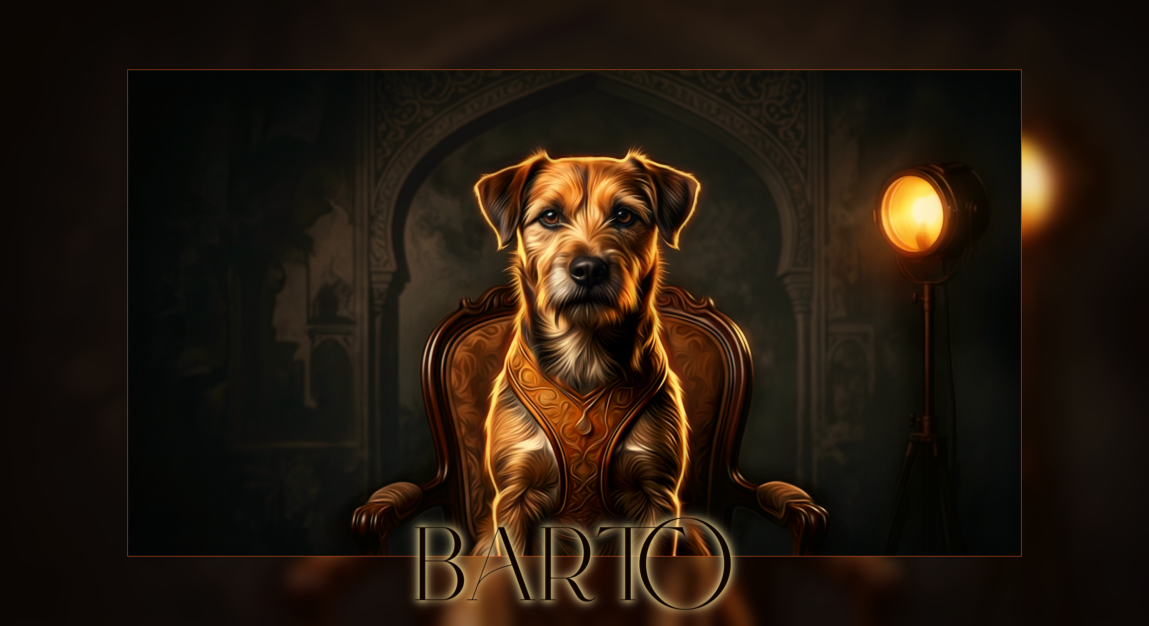
Barto, the clever terrier mix, was born a street dog. For the first year and a half of his life, his entire existence was about survival—searching, finding, and securing food, water, a place to sleep, and shelter in the vast city of Tehran.
But one day, he just sat there, right in front of Nima and Sahar's front door. Somewhere deep down, his little canine soul sensed that this was his future home; that here, he would be accepted, loved, and cared for. For three days and three nights, he didn't budge. He just stayed there, lying by the doorstep.
Nima put out a bowl of water and gave him some food, fully expecting him to move on afterward. But when Sahar noticed that Barto was still there after three days, refusing to leave, she spoke with Nima. Right then and there, they decided to take him in.
They named him Barto because of the pure joy of life he radiated. In Persian, Barto carries the meaning of "the bright one" or "the shining one."
Truth be told, dogs should always choose their owners, never the other way around. If they did, half of all animal shelters would probably be able to close down. Why? Because a dog's soul is simply much better at making that choice.
Now, one might think a photography studio operates under a strict sense of order. But then again, one doesn't know Barto. The moment the studio lights flared to life, the true master of the house had already claimed the prime spot: a beautiful, elegant chair, where he sat enthroned like a little king.
In the end, all that was left for me was a simple wooden crate right next to him. But that is exactly how hierarchy works—some creatures possess an innate sense of dignity, no lineage required.
Barto squared his shoulders and stared directly into the black monster of a camera lens as if he had spent his entire life posing for the front covers of major magazines. A click, a brief flash, and just like that, the four-legged character study was captured forever.
We all laughed, the photographer completely forgot his professional sternness, and the true star of the day finally received his well-deserved sausage. It was the last joyful picture before a journey that would turn our lives completely upside down.
Chapter 3: Bad News with Good Coffee
On the uncomfortable truth that life rarely sticks to the timetable.
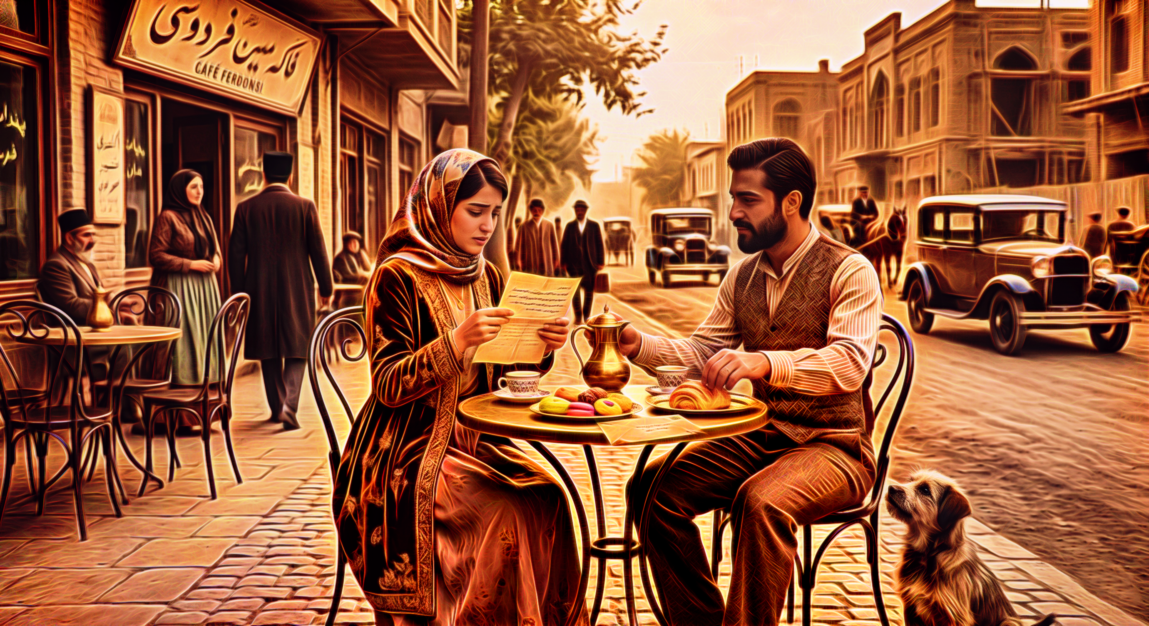
It was a perfectly ordinary Tuesday morning in Tehran. Just like every Tuesday morning, Nima, Sahar, and Barto sat at their favorite sidewalk café.
The café owner was a devoted admirer of Qamar-ol-Molouk Vaziri, the legendary first woman to sing before a public audience in Persia without a veil. It was precisely her shellac record spinning on the gramophone that morning. Right in the middle of the bustling city crowd, her magnificent voice echoed, underscored by the signature crackle and pop of the gramophone needle.
Two cups of coffee, still steaming. A city roaring as if nothing could ever slow it down. And at our table: a sudden, iron silence. It is a strange thing with letters—they weigh only a few grams, yet in a single second, they can crush an entire future.
The lines Sahar held in her trembling hands were from her beloved grandmother in the south. They brought devastating news of a sudden, severe illness. It wasn't a farewell note; it was an urgent cry for help.
Nima said nothing. He just stared at Sahar, watching her face turn pale as she read, trying to measure the scale of the catastrophe before it even had a name. Even Barto knew the game had changed. He wasn't sleeping. He sat there like a stone monument, his head tilted, his dark eyes fixed on the paper as if he could read the unspoken misery hidden between the lines.
Ten minutes ago, we were travelers on the verge of a long-awaited vacation. Now, we were a rescue team with a ticking clock. Tehran was already fading—the real journey began right here, over a cooling cup of coffee.
The planned vacation was ancient history. Sahar's heart filled with overwhelming worry, anxiety, and a creeping panic. Nima knew he had to keep a cool head now. He comforted her and immediately took charge of all the logistics to ease the heavy burden on her shoulders.
Would they really make it to the grandmother as fast as possible, without any obstacles standing in their way?
Chapter 4: The Rolling Waiting Room
When steam engines are fast, but a beating heart is faster.
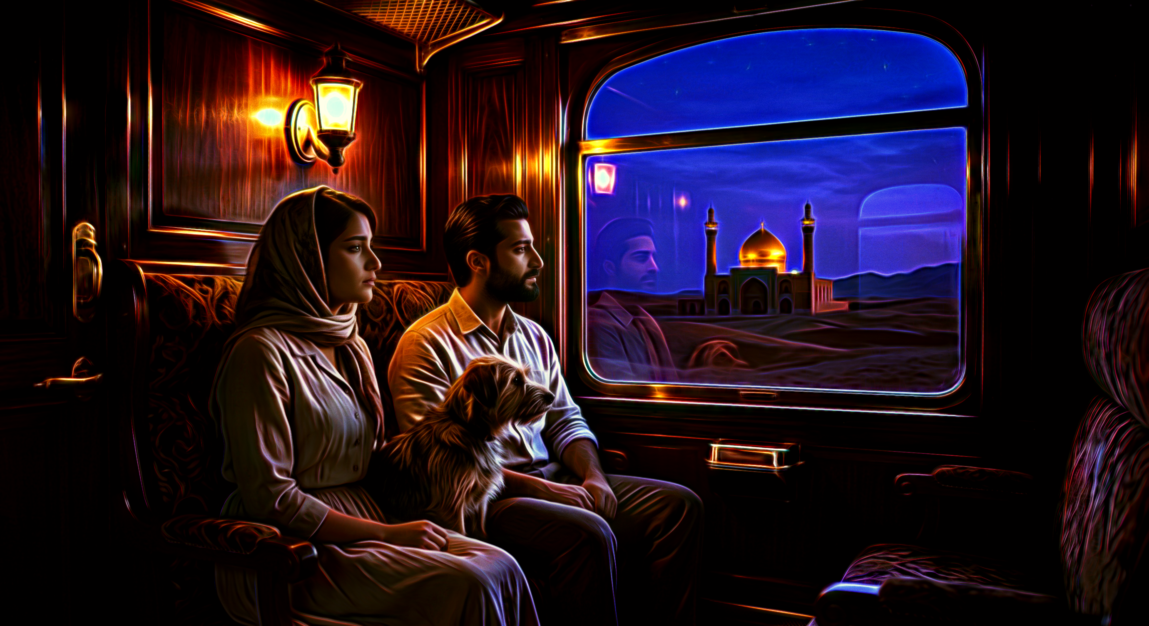
If trains did not exist, they would have to be invented for people who need to flee from their own thoughts. A railway carriage is a wonderful thing: it is a moving waiting room, a temporary home on steel wheels, and its children bear very practical names: Distance, rhythmic clatter, and passing landscapes.
The passenger sits there, gazes out the window, and feels incredibly important simply because they are moving forward—even though, in truth, they are doing nothing but sitting on a plush cushion, waiting for the world to change.
We sat in our compartment while the heavy steam locomotive huffed rhythmically, pulling us relentlessly south, away from Tehran. It truly felt like a marvel of engineering—tons of pure, roaring steel forcing the passenger cars through the rugged terrain. Outside, the telegraph poles flew past like thin, black exclamation marks; inside, the air was thick with the scent of old upholstery, travel dust, and a silent, unspoken fear. We were moving fast, but our worries were faster; they had already arrived at the destination long before us.
Sahar sat by the window, her eyes fixed on the vanishing horizon, as if she could read the future in the swirling dust of the desert outside. Nima's face was etched with thought, his hands resting heavily on his knees. He looked like a man trying to solve a mathematical equation for which no solution exists.
And Barto? Barto had made himself comfortable between the two of them. He cared nothing for the speed or the shifting scenery.
Nima's mind kept racing back to the same agonizing thought: Would the train actually arrive on time? Because the next vessel of their journey was already waiting at the coast, and time was a luxury they simply did not have.
Chapter 5: Monsieur Jean-Luc’s Masterpiece
On the priceless good fortune of meeting the right person in the wrong train.
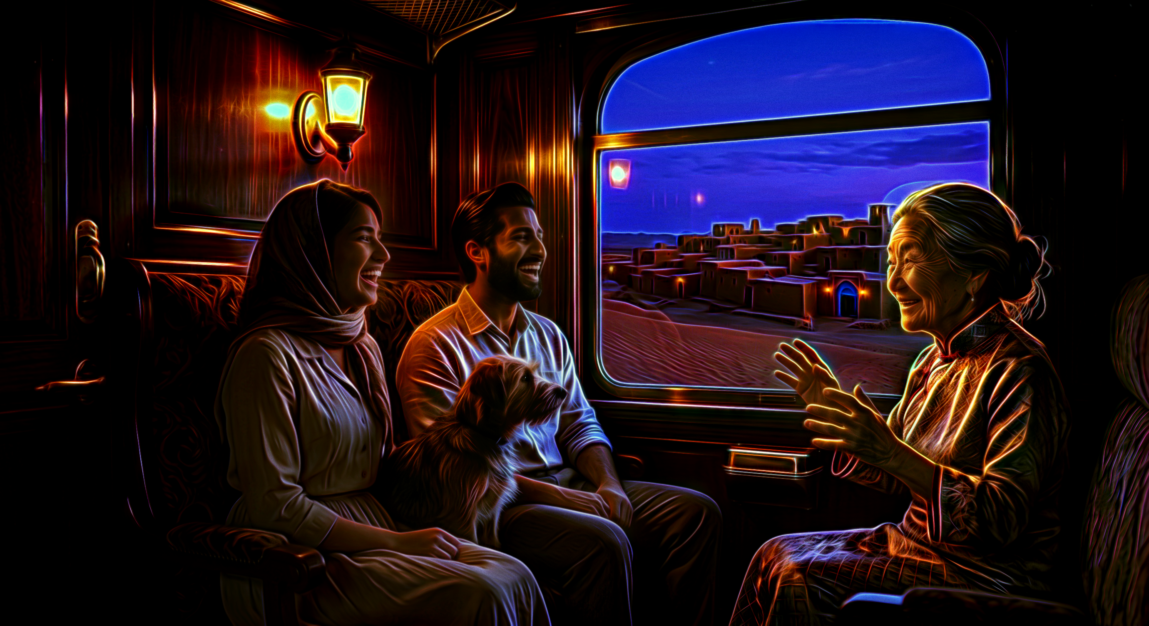
Humor is a strange, beautiful gift. It asks for no permission; it simply arrives when the burden grows too heavy, forcing a shift in perspective when a crisis threatens to paralyze the mind. True humor always comes unexpected—sometimes disguised as a stranger who boards your train in the middle of the night.
At the last remote station, the heavy wooden door of our compartment had slid open. Until then, Nima, Sahar, and Barto had been completely alone with their fears. Now, an elderly Chinese woman sat across from us. She had travelled thousands of miles to Persia to visit someone incredibly special: Parvin Khanoom, a lifelong pen pal she had exchanged letters with for decades, but had never actually seen in person until this trip.
For the first few hours of the journey, she had remained entirely silent, watching the desert roll by. But as she observed Sahar's heavy heart and Barto's watchful, guarded eyes, she suddenly broke the silence. She did not ask about the looming tragedy in the south. Instead, perhaps inspired by her own long history of written words, she chose to speak of another "Frenchman" who had once dictated her life.
"I lived with a Frenchman for many years," she said, her smile dry and knowing.
"One afternoon, I cooked my absolute favorite dish: deep-fried fish. It sat on the dining table, crispy and perfect. I was just about to take my very first bite when there was a knock at the door. It was my neighbor, begging for three eggs to bake a cake. I walked into the kitchen, gathered the eggs, and handed them over. But when I returned to the table, the plate was completely bare."
She paused, ensuring our undivided attention.
"The fried fish was gone—devoured by the Frenchman with whom I had shared my life for years: Monsieur Jean-Luc, my gluttonous French Bulldog."
We stared at her for a heartbeat, and then the laughter hit us like a sudden wave, washing away the suffocating silence that had filled the compartment. Even Barto looked up, tilting his head as if he thoroughly approved of his French colleague's criminal energy.
For a few priceless minutes, the train, the heavy worries, and the fading silhouette of Tehran vanished entirely. There was only an old woman, a stolen fish, and the liberating realization that the best companions on a dark journey are those who can make you smile when you least expect it.
But the laughter faded as the train slowed down. The clock was ticking, and the sea was waiting.
Chapter 6: Between Steam and Dome Glow
On the strange fact that a harbor smells of farewell, but looks like a beginning.
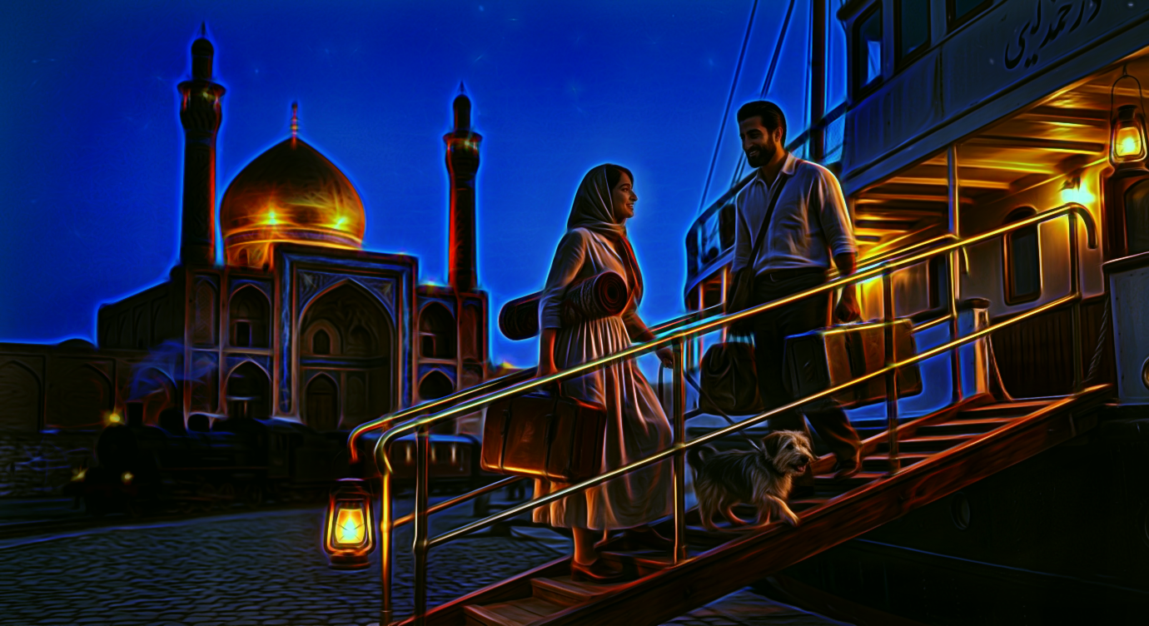
Saying goodbye to Madame Lin Meilan was harder than we expected. We would have gladly traveled much further with her; her warmth and laughter had been like a comforting, golden sunrise after a dark, freezing night. But harbors are places of transition, and the peace of that moment was borrowed.
One might think a nighttime harbor is no place for romance. The air hangs heavy with the scent of tar, salt, fish, and farewell. Beneath our shoes, the wet cobblestones glistened like the scales of a tired, ancient fish, and the oil lamps flickered along the pier as if they suffered from asthma. Yet every now and then, the world holds its breath, sheds its gray everyday attire, and dresses up for the night.
But the illusion shattered the moment we stepped onto the wooden deck.
The thick mooring ropes were cast off, and a black, yawning gap began to widen between the ship's hull and the stone pier.
Ships, Nima thought to himself as the engines began to thrum beneath his feet, are like floating libraries. Within a few square meters of teakwood, entire human anthologies unfold. People love here, they hate, they mourn, they kill. Sometimes a new life enters the world on a ship, and sometimes a person's eyes close forever to the rhythm of the waves.
A veteran captain, fueled by a good whiskey and a pipe of tobacco, could spend days and nights telling the most incredible stories.
But Nima's philosophical thoughts vanished in an instant.
As the ship slowly drifted away from the dock, he cast one last glance back at the faint, asthmatic glow of the streetlamp near the railway tracks—and froze. There, standing dead still in the shadows of the panting steam locomotive, was a silhouette that should never have been able to follow them.
The figure slowly raised a single arm, pointing directly at their departing ship. A shiver ran down Nima's spine as the harbor faded into the dark. Who was watching them?
Chapter 7: A Fragrance Against the Darkness
On the bravery of making oneself beautiful for the evening while the future remains in the dark.
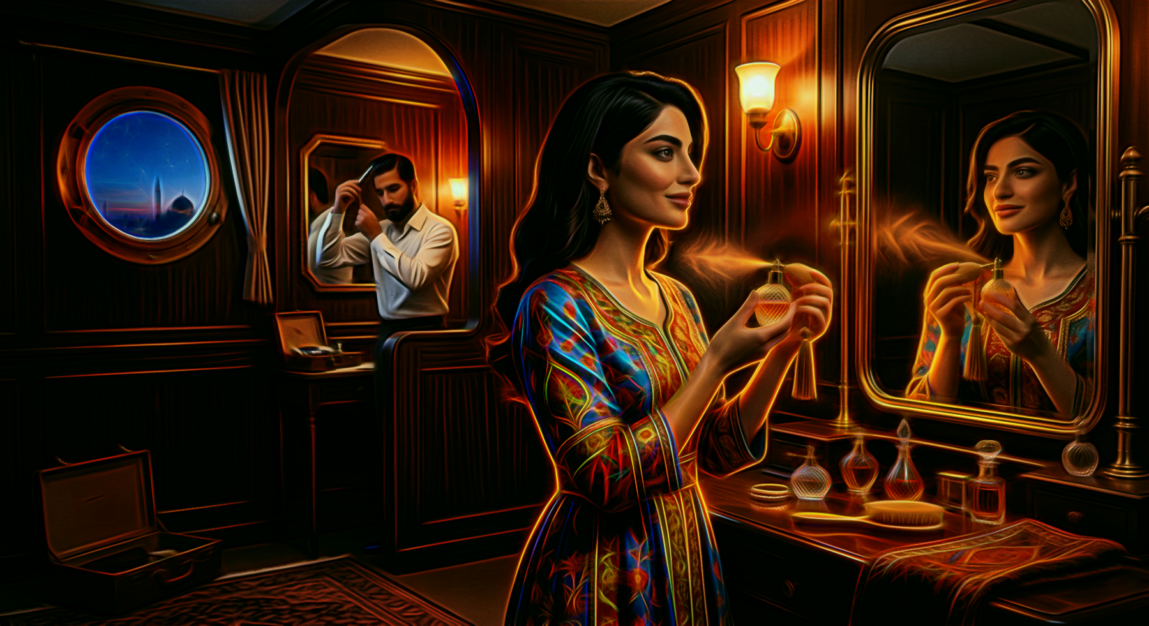
One can easily flee from the heavy worries of life into a comfortable ship's cabin crafted from heavy teakwood, but unfortunately, you always bring your own heart along. Such a room on a southern steamer is a strange sanctuary: its wall lamps cast a light as warm as liquid amber, pretending the entire world is nothing but a cozy, safe parlor.
You open your suitcase and try, if only for an hour, to forget the suffocating tension of the past few days. For humanity possesses an admirable talent: the more uncertain the coming days become, the more thoroughly we comb our hair.
Sahar stood before the large, rectangular vanity mirror, preparing herself for the evening. Her long, dark hair fell loosely over the shoulders of her magnificent, intricately patterned Persian gown. She pressed the vintage atomizer of a classic perfume bottle, and a luminous, golden trail of fine mist settled against her neck—a tiny, fragrant fortress built against the uncertainty of their journey.
It was a fragrance that instantly silenced the room. Heavy, dark, and filled with a hypnotizing warmth that hung in the air like spun gold. First came the sweet, almost smoky note of precious oud and ripe Persian Damask rose—an opening as deep and velvety as the night sky over the ocean.
Yet directly beneath it, the perfume's true secret revealed itself: a warm accord of creamy sandalwood, sweet amber, and a delicate touch of precious saffron that shimmered in the air like fine, golden dust. It smelled of centuries-old bazaars, of sacred oils, and of a profound, unshakeable sense of security that made one completely forget the chill of the sea breeze outside.
The large, round porthole with its heavy brass frame served as a silent reminder that they had finally traded the solid ground of the railway tracks for the open water. The curtain had been elegantly drawn aside, offering a view of the deep blue, star-strewn night outside.
On the distant horizon, the delicate, illuminated silhouettes of oriental domes and minarets traced themselves against the sky—the quiet witnesses of the harbor they were leaving behind, slowly fading into the darkness as the ship carried them further south.
Chapter 8: Wild Hair and a Chain of Longing
Of a German archaeologist who reads the world map through the eyes of his wife.
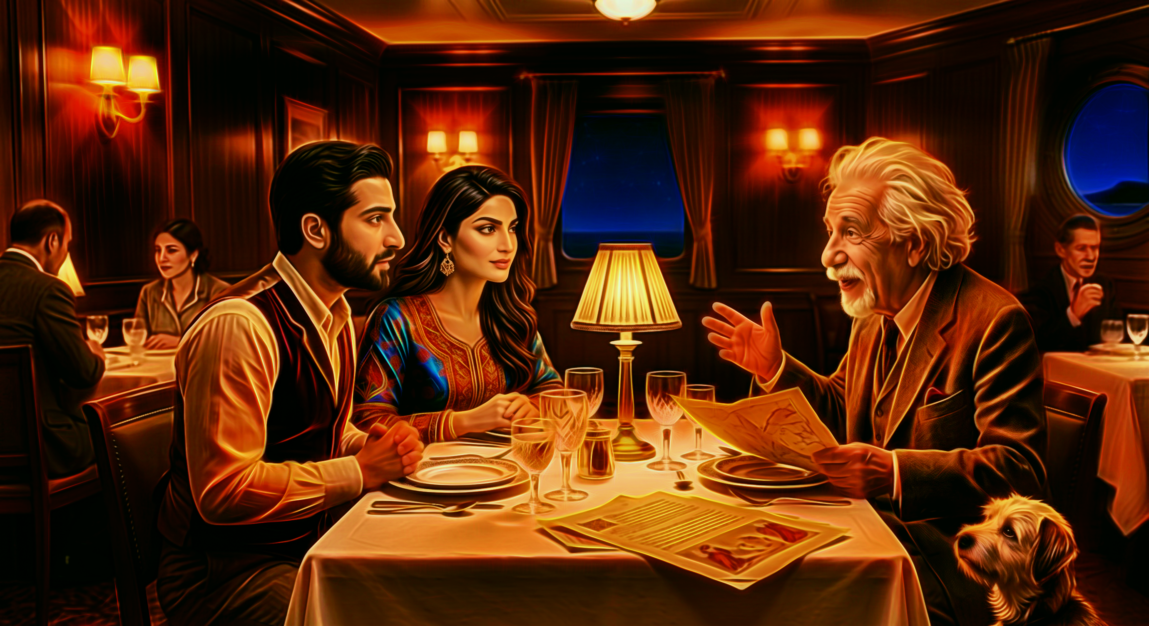
One might think a festively lit dining saloon on a grand ship is a place of carefree joy. Glasses clink softly, the white tablecloth gleams in the amber glow of the table lamp, and the waiters serve the soup with the sleepy elegance of old routine. You sit there, trying to forget the chilling specter of the harbor, and at first, you don't even notice that at the very same table sits a man whose heaviest piece of luggage is invisible to the naked eye: a broken heart.
Sitting across from us was Emil Gruber. A German archaeologist with wild, white hair that looked as though it stood in permanent conflict with the wind, and a thick mustache. At first glance, he seemed like the caricature of an absent-minded scholar, but the moment he began to speak, Sahar and Nima froze mid-motion. His voice was quiet, almost fragile, and in his eyes lay a sadness as deep as the cobalt-blue sea shifting outside the ship's window. He spoke of Martha. His Martha.
They had shared everything for a lifetime: a love for history, discoveries in the dust of centuries, and one great, luminous dream. Martha had been utterly fascinated by the legendary pearls of Qeshm Island. She had spent years reading and researching, and in her mind, she had already visited every corner of that distant Persian island. It was meant to be the journey of their lives—the reward for all the lean years.
But fate cares nothing for life plans. Death came far too early, merciless and quiet, simply scratching the dream off the ledger. Emil told us how he sat by her deathbed, holding her slender, powerless hand, feeling the world slip through his fingers. In her final minutes, Martha looked at him and asked for a single promise in a fading voice: "Go for me, Emil. Make the journey for me. Carry me in your soul to Qeshm, so that I may see it through your eyes."
As he spoke these words, his right hand trembled, clutching Martha's left-behind documents and notes as if they were the most precious relics on earth. He was not traveling to discover something new. He was traveling to fulfill a promise given to a dying woman. Martha was in that room with every second, every breath, and every heartbeat. He had brought her on board so she could experience physically what life had denied her.
Dead silence hung over the table. Sahar stared at him, her large eyes swimming with deep emotion—a single tear glistened in the lamplight, ready to fall at any moment. Nima sat with his hands tightly clasped upon the cloth, unable to speak, because any word in that moment would have been too small. Even Barto, our scruffy little dog, sat perfectly still. He looked up at the old man with his dark, wise eyes.
Yet, as Herr Gruber noticed the distress of the two young people and saw Sahar secretly brush the tear from her cheek, his expression shifted. He refused to leave these young souls, who still had their whole lives ahead of them, trapped in his melancholy. A faint but infinitely warm spark lit up his eyes, his mustache twitched, and with an almost youthful, lively gesture, his right hand tapped the menu. An amused, deeply honest smile broke through.
"But look at me!" he said, his voice suddenly regaining a powerful, infectious enthusiasm. "Martha did not give me a mandate to mourn, but a mandate to live! You two have the future in your pack, you have each other—and that is the greatest archaeological miracle in the whole wide world. Let us not weep for what is past, but celebrate what lies ahead!"
In that moment, as the golden light of the table lamp illuminated his enthusiastic face, we felt that this wonderful man had just given us the most valuable thing one can find on a dark journey: courage. And as the ship carried us further into the night, we knew that Martha's true legacy—an old parchment with a secret plan—was waiting out on deck to change our fate forever.
Chapter 9: The Golden Light Outline of the Night
On the strange phenomenon that a stormy ocean almost looks like art in the glow of the ship's lanterns.
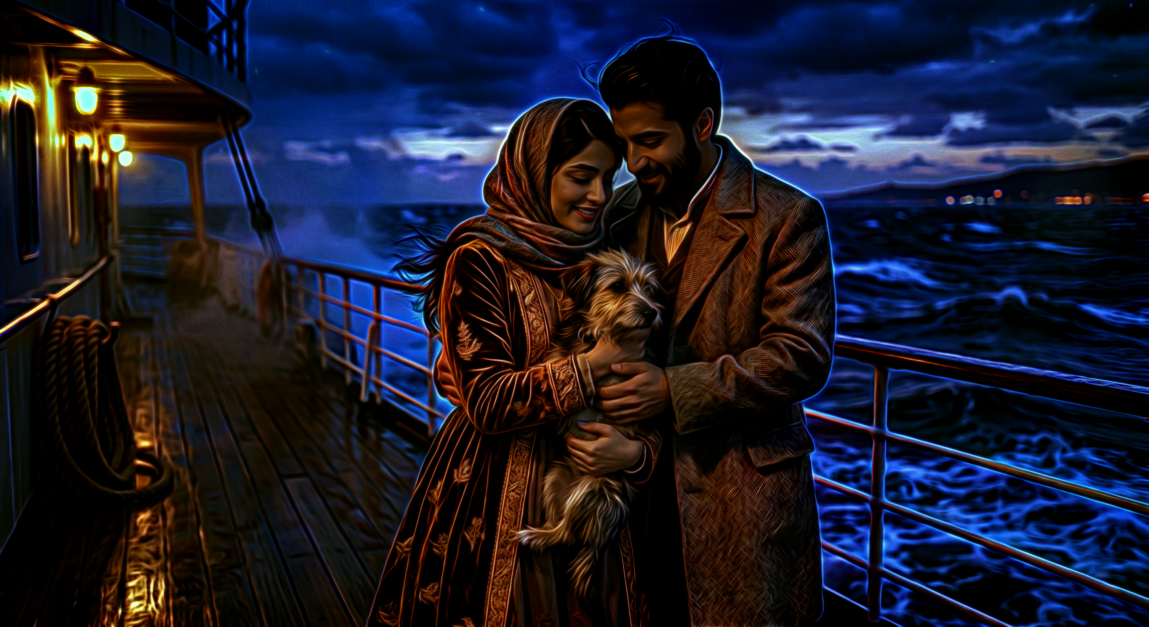
Some nights at sea are not made for drawing grand plans. Instead, they exist to remind humanity just how fragile we are when measured against the wrath of a restless ocean. The warm lights of the dining saloon, the rich flavors of our meal, and the hauntingly beautiful story of Emil Gruber and his Martha lay barely an hour behind us—yet they already felt like a distant memory from another lifetime.
Out on deck, the world had completely transformed. A raw, biting wind swept across the wooden planks, and the sea had turned treacherous. The steamer's teak floor glistened, slick with the ocean spray that occasionally breached the railing, while heavy, bruised clouds hung low in the night sky, threatening to swallow the ship and all its passengers whole.
Sahar and Nima stood pressed tightly against the guardrail, defying the elements. The wind tugged violently at their heavy coats and whipped strands of Sahar's dark hair from beneath her patterned headscarf, but they held their ground—a tiny, stubborn fortress against the encroaching cold.
Amidst this deep, suffocating cobalt blue, Sahar held scruffy little Barto safely in her arms, while Nima wrapped his own arm around her in silent support. The dog, his tangled fur slightly disheveled by the gale, had grown remarkably still. He stared calmly out into the churning waters, as if his canine soul understood that the stakes had changed tonight. Nima leaned his head tenderly toward Sahar, his sharp beard catching the golden contours of the ship's lanterns—a silent, unspoken vow that he would hold her steady, no matter how fiercely the waves crashed against the wooden hull.
On the distant horizon, a tiny necklace of lights from a faraway city flickered against the dark. It was a beautiful sight, undoubtedly, but tonight, the world had shrunk to a single point. Emil Gruber and his mysterious parchment could wait a little longer. For now, in the teeth of the rising storm, the only thing that truly mattered was the warmth they found in each other.
Yet, as the waves swelled higher, the shadows on deck seemed to lengthen, holding secrets that the morning light would soon force them to confront.
Chapter 10: When the Sea Holds Its Breath
Of the quiet minute on deck, in which a departed woman takes the lead.
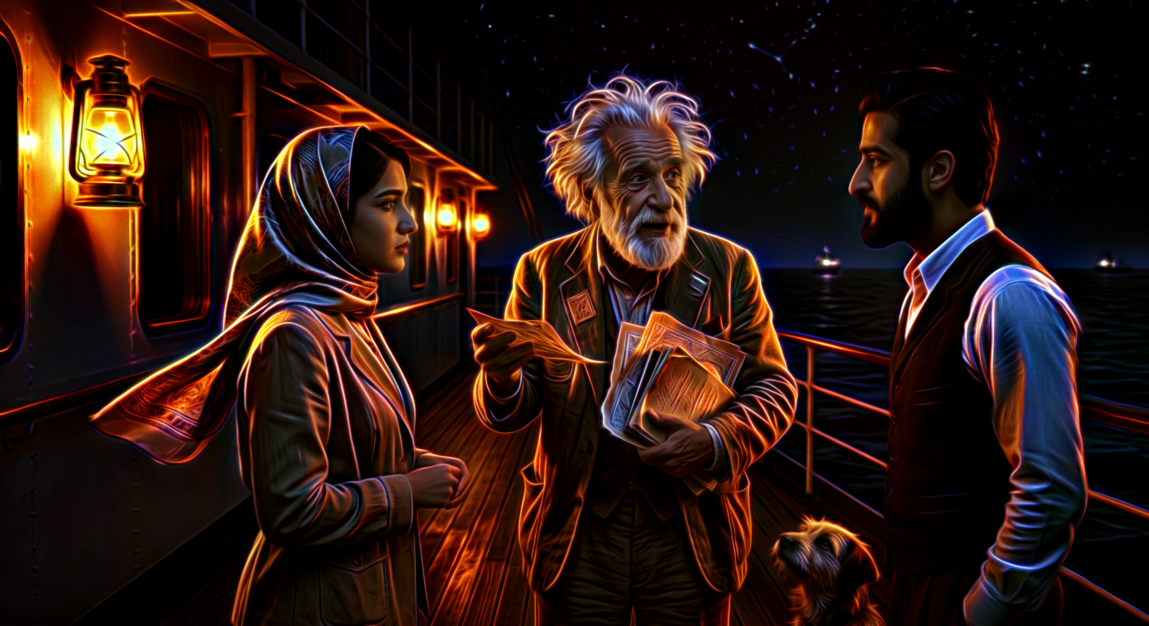
The sea is a fickle companion. Barely an hour had passed since the gale whipped cold spray into our faces, yet the ocean had already mirrored a perfect calm, as if trying to apologize for its foul mood.
The waves fell silent, the wooden deck planks caught the warm, orange-gold glow of the storm lantern, and above us stretched a pitch-black sky so thick with stars you would think someone had spilled a box of diamonds across black velvet. In the distance, two other ships lonely tracked their course, their tiny position lights flickering like fireflies upon the water. It was the perfect stage for a secret.
We stood in a semi-circle on deck—Sahar, Nima, faithful Barto, and Emil Gruber. The professor had carried that wonderful, infectious enthusiasm straight from the dining saloon out into the night. His wild, white hair glowed in the lantern light like a tiny galaxy of its own as he presented an unfolded sheet of paper with lively, animated gestures.
In his left hand, he still clutched the thick bundle of Martha's letters, but this single piece of parchment was the heart of it all. It was Martha's map, tracing the path to a hidden cave on Qeshm Island. Then, the professor did something that stole our breath away: with a solemn, deeply deliberate motion, he placed the parchment directly into Sahar's hands.
Seeing the silent protest rising in Nima's eyes, the archaeologist smiled gently. "Do not worry, my young friends," the scholar whispered, parting his striking beard into a sly, knowing grin. "I am not breaking my promise to Martha. I have studied this map for years; I know every point, every stone, and every path entirely by heart. I carry Martha's route in my mind and in my soul—I will find that cave even without the paper.
But I want the two of you to carry this parchment with you as a gift. Martha loved life, and she would be overjoyed to know that her map is giving courage for the future to two wonderful young people."
Sahar held the old paper as if it were spun from pure gold, her patterned headscarf blowing elegantly back into the gentle night breeze, her face filled with deep, reverent contemplation. Nima stood opposite her, hands casually buried in his pockets, his gaze fixed on the professor with the utmost respect.
At their feet sat Barto, his head tilted upward, looking at Herr Gruber so devoutly it felt as though the little dog understood that a true miracle had just changed hands. In the stillness of that quiet night, it became clear to us: Martha's dream had just become the compass for us all.
Chapter 11: A Promise in the Address Book
Why some farewells at the harbor carry the scent of Tehran, while the next adventure waits on four wheels.
When we finally stepped off the wooden planks of our faithful steamer and set foot on the solid ground of the harbor, a heavy sense of melancholy hung in the air. Over the past few days, strangers had truly become friends.
Before the final goodbye, addresses were hastily scribbled on scraps of paper and exchanged. From the bottom of their hearts, Sahar and Nima invited Emil Gruber to visit them in Tehran—a solemn promise of hot tea, endless conversations, and a proper reunion back home. The professor accepted the invitation, a faint, emotional glint in his eyes.
Though he couldn't say exactly when his archaeological paths would lead him back to the capital, it was absolute certainty that he would come. And so our paths diverged, but Martha's map remained in our pocket like an invisible, binding thread.
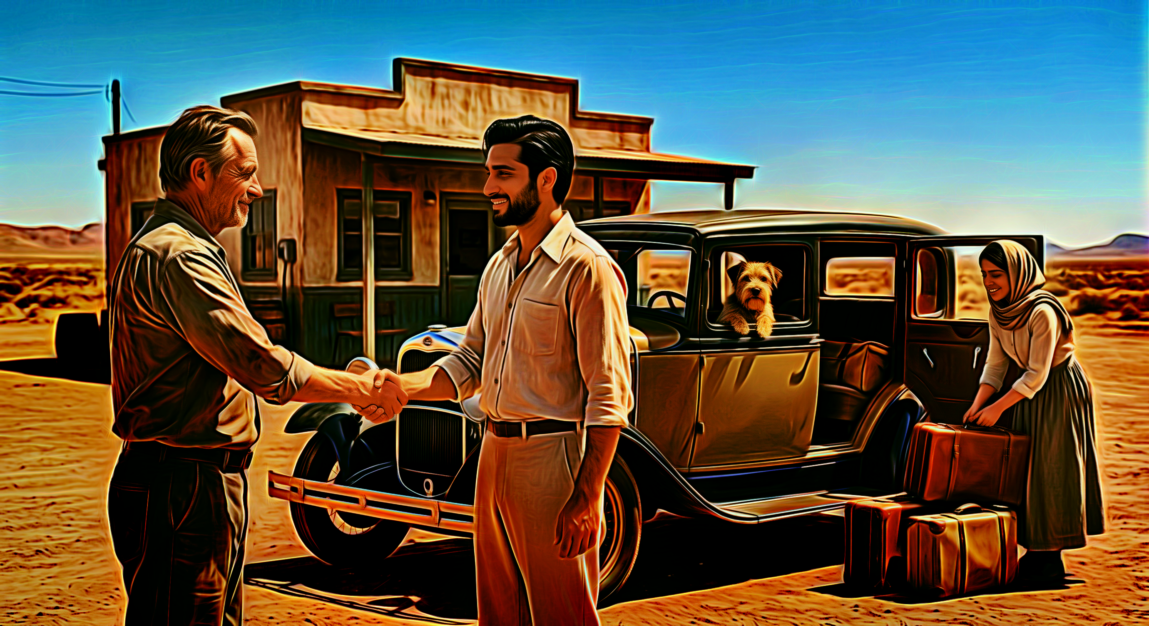
Only a short time later, we found ourselves plunged into a world so mercilessly beautiful it stole our breath away. The cool, dark night upon the sea had vanished entirely. Above us stretched a vast, cloudless sky of an intense turquoise blue, looking as though the horizon had just been freshly painted, while the desert floor beneath our shoes shimmered in warm tones of gold and ochre.
Against the rustic backdrop of a single-story wooden building, we sealed the next chapter of our journey. Nima stood in the shimmering midday sun, an honest smile on his face, shaking hands with the car rental agent. The older man, with his slicked-back, greying hair, went by the name of Mehrdad Wilson.
He returned the handshake with the satisfied composure of a businessman who knows that a man's word still carries weight in the south. Mehrdad was the son of an American who had once fallen deeply in love with a Persian woman on Qeshm Island and chose to stay. While his father had rented out horses, mules, and carriages, Mehrdad had adapted to the new era.
Behind them, our new companion gleamed in the harsh sunlight: a dark, elegant 1930s sedan, boasting proud, freestanding fenders and polished chrome bumpers. While Sahar, smiling joyfully, handled the classic brown suitcases at the open rear door with admirable energy, the true boss of the day had already claimed the prime spot.
Little, scruffy Barto peered curiously out of the open driver's side window, looking for all the world as if he were about to demand the ignition key. We had solid ground under our tires, three suitcases in the back, and a road ahead that was simply waiting to be conquered.
Chapter 12: Strike in the Desert Night
On the uncomfortable truth that even the most beautiful limousine sometimes takes a smoke break.

It is a well-known fact that fate possesses a keen sense of drama and a distinct fondness for terrible timing. The limousine, which only a few hours ago had so proudly kicked up the desert dust, had suddenly decided that its thirty horsepower were officially done for the day.
With an offended, sputtering hiss, our journey ground to a halt in the dead of night. Now the car stood there, its hood propped wide open like the jaws of a tired crocodile, letting a thick cloud of smoke drift lazily into the sky. The large, round headlights illuminated the ground ahead, as if trying to hold the sand itself responsible for the sudden breakdown.
Sahar and Nima stood beside the stranded vehicle, exchanging glances. In Sahar's eyes lay a quiet, anxious question as she pulled her heavy coat tighter around herself. Nima returned her gaze with the calm resolve of a man who knows that cursing in the middle of nowhere won't cool down a boiling engine. They thought of the ailing grandmother whose rescue was the very purpose of their journey, and of Martha's mysterious map tucked safely away in their pocket—the road was still so long, and now this.
Yet, while the two of them debated their next move, the only carefree passenger in the world had already taken his station. Little Barto peered faithfully out of the open driver's side window. Sitting proudly behind the steering wheel, he looked as relaxed as if a sudden breakdown in the desert was simply a standard itinerary item for a proper expedition.
Around them, the desert night was profoundly still. We were stranded, the engine was dead, and civilization was miles away. Yet just as the heavy darkness threatened to swallow us whole, Nima narrowed his eyes, staring intently into the distance. Out there, on the absolute edge of the horizon, a tiny, rhythmic shimmer was moving through the sand.
Was it a nighttime mirage, a cruel trick of his exhausted nerves, or was the vast solitude of the desert finally causing him to lose his mind?
Chapter 13: From Cylinder Heads to Humps
Why a true ship of the desert never needs a smoke break, and a woven basket is sometimes the best place in the world.
There are moments when so-called modern civilization proves to be a rather overrated construct. You find yourself standing in the middle of nowhere, the cylinder heads are on strike, and the headlights of the rental car flicker faintly, casting a rather embarrassed glow across the dunes.
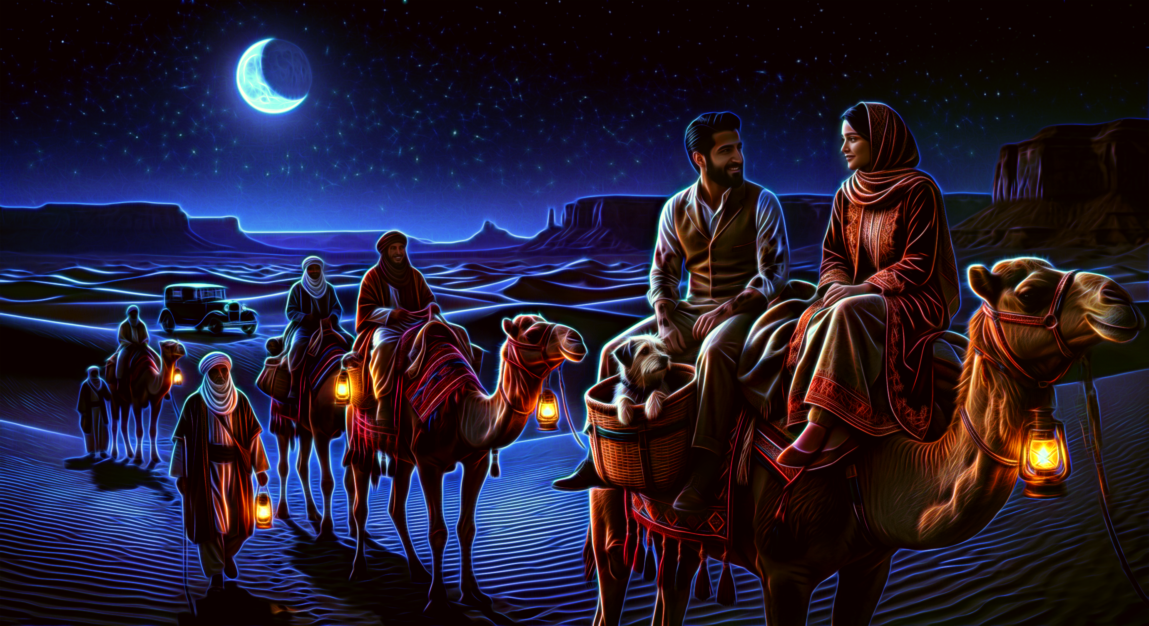
Yet at the exact moment Nima began to doubt his own sanity, the mysterious shimmering on the horizon turned out to be no mirage at all. It was a rescue of a far more elegant kind: a small caravan emerged silently from the darkness, led by men whose lanterns threw a warm, golden sheen into the star-strewn night.
Before we knew it, we had traded the unreliable limousine for the majestic pace of the camels. Sahar and Nima sat high atop the stately lead animal, exchanging relieved, smiling glances. As the caravan moved in a gentle rhythm past the massive silhouettes of rock formations, little Barto had long since accepted his promotion in a thoroughly dignified manner.
He sat comfortably inside a woven basket dangling from the side of the saddle, peering faithfully ahead. Beneath the cool light of the crescent moon, the procession advanced relentlessly through the sand.
The caravan leader went by the name of Mirza Farid. He was an experienced guide in the fifth generation, having learned the art of reading the stars from his grandfather. Traveling the vast expanses since childhood, he had learned to read the desert like an open book, letting the celestial bodies guide him safely to his destination. Mirza Farid used to say: "The sky does not lie, and the sand remembers every single step."
To Mirza Farid, the stars were a reminder of what is above, and the sand a reminder of what is below. Together, he believed, they taught humility: a man must think clearly, breathe calmly, and neither overestimate his own stature nor consider his own weakness to be final.
Yet, the closer we drew to our destination, the heavier a terrible question weighed upon our hearts: Would Grandmother still be alive when we finally managed to reach the village—or were we, in the end, already too late?
Chapter 14: The Currents of the Heart
On the healing primal force of a love that goes deeper than any illness, bringing back the will to live and recovery.
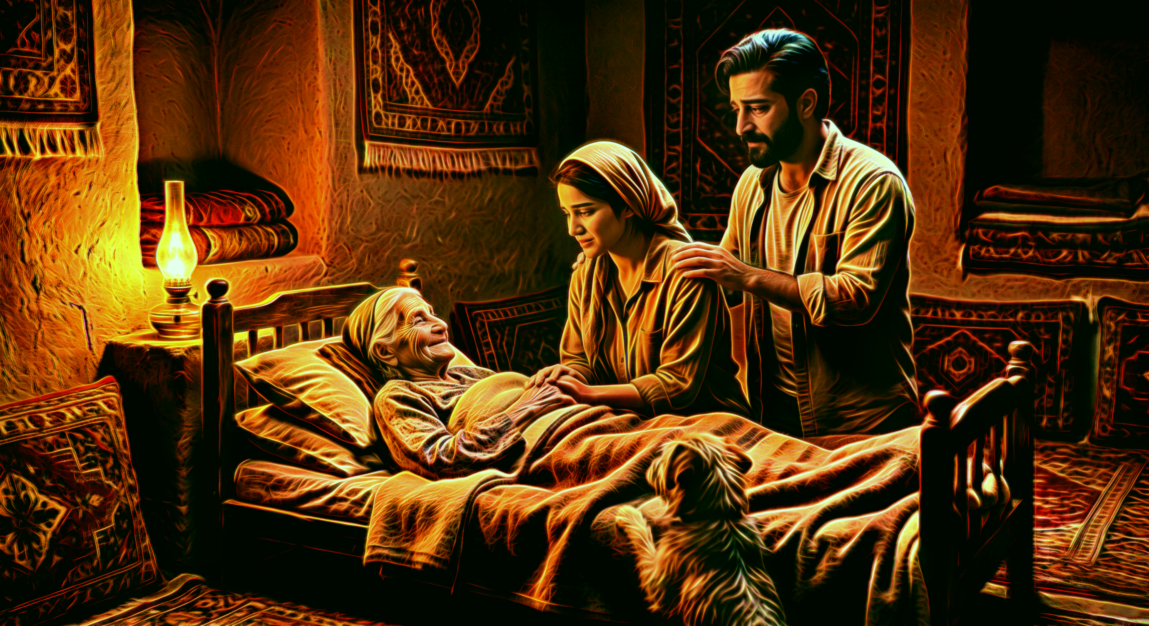
There are moments in life when fear grows so colossal it threatens to suffocate the very heart within you. The moment Sahar crossed the threshold of the small room and caught sight of the wooden bed, a violent shock ran through her.
Her beloved grandmother looked frighteningly emaciated, fragile, and deeply marked by suffering, as if she had become a mere shadow of her former self over the past weeks. Yet the sudden paralysis immediately gave way to pure, unadulterated longing. Filled with a mixture of pain and profound relief, Sahar rushed to the bedside, weeping as she threw her arms around the old woman—a fierce, tender fortress built against death itself.
She sat close to the edge of the mattress, taking the grandmother's slender, powerless hand and wrapping it tightly in her own. Right then, the true, incomprehensible miracle of this long journey unfolded: the endless, deeply rooted love of the granddaughter began to flow like a warm, pulsing current of energy. It poured directly through their joined hands, seeping straight into the grandmother's weary soul and weakened body.
This profound devotion pierced the old woman to the very bone, driving out the icy chill of exhaustion and awakening her life force in a way no medicine on earth ever could have forced. The wonder happened right before their eyes: the sharp lines of the grandmother's face softened, and a gentle, infinitely tender smile returned to her lips. The process of healing had begun, carried entirely by the raw power of emotion.
Behind Sahar knelt Nima. His chest, too, beat with a profound, sincere love for the old woman whom he had long since welcomed into his soul as his own grandmother. His hand rested on Sahar's shoulder, a steady source of tenderness and supportive strength, while his gaze remained fixed in absolute reverence on the smile resting upon the pillow.
They were no mere bystanders here; they were an inseparable trinity of love and life. And right in the center of it all, Barto offered his own quiet vow of loyalty at the bedside. With an infinitely gentle gaze, the little dog had softly placed his paw upon the blanket, close to the grandmother. In that tiny room, bathed in the golden-orange glow of the oil lamp, the grandmother was simply loved back to health that night by Sahar, Nima, and Barto.
The vast desert, the breakdowns, and the storms were entirely forgotten—all that remained was the absolute triumph of the heart. Yet, as the light of the oil lamp flickered softly against the wall, one final question lingered in the quiet room: Would the strength of these three hearts truly be enough for her to fully recover?
Chapter 15: The Blooming of the Roses
Of four weeks full of appetite, regained strength, and the wonders of a Persian garden.
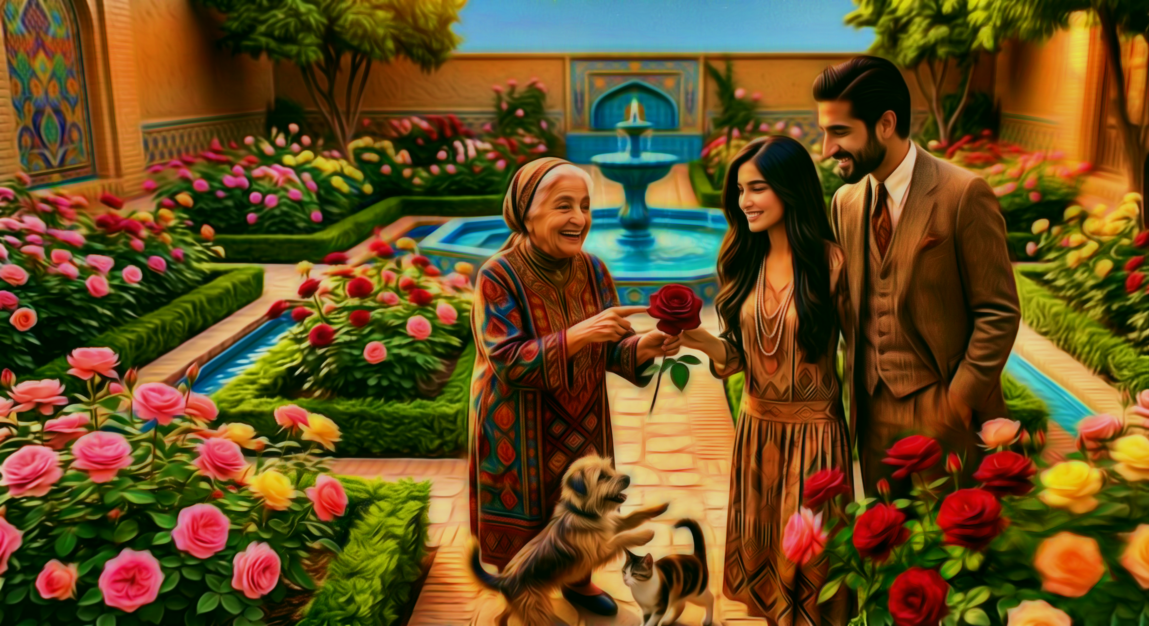
There are recoveries that do not take place within sterile hospital walls, but in the warm afternoon light of a blooming garden. A full four weeks had passed since fear had been our constant traveling companion, and today, it seemed almost impossible to remember the icy chill of that sickbed.
Grandmother had long since left her bed behind and—to our greatest, secret joy—had truly regained her weight. Nothing remained of her frighteningly emaciated state; her cheeks were full, her vital energy had returned, and an irrepressible, infectious joy of life danced in her eyes.
As she stood amidst the magnificent rose bushes and proudly handed us a single blossom, we knew that love had finally won the battle.
Sahar and Nima stood arm in arm beside her, the smiles on their faces as bright as the cloudless sky above. The soft splashing of the courtyard fountain sounded like the accompanying music to a new, happy life. It was right here, when Sahar was just five years old, that she and her grandmother had planted a rose bush together—the very same bush from which Grandmother had just plucked this blossom.
Beautiful childhood memories came rushing back to Sahar. She remembered the countless stories Grandmother used to tell her by the fountain; they had shared such a wonderful time back then.
Yet the true spirit of the garden unfolded a few paces away. In the meantime, Barto had found a loyal ally: a young cat named Shirina—a name that, in Persian, beautifully translates to "the sweet one." The two were twin souls, and over the past weeks, the clever Shirina had even taught the scruffy terrier how to successfully catch flies mid-air.
Right now, Barto was trying with all his might to wildly entice his new friend into a game, while Shirina looked up at him with curious eyes. After all the storms at sea, the breakdowns in the desert night, and the anxious hours of waiting, peace had finally arrived—the very peace we had searched for so long.
Yet, as we breathed in the sweet scent of the blossoms, a quiet question crossed our minds: How long would Nima, Sahar, Barto, and Shirina be able to enjoy this carefree time here at Grandmother's side?
Chapter 16: The Night Before the Departure
Or: How to forget the worries of the past forever in the rhythm of the music.
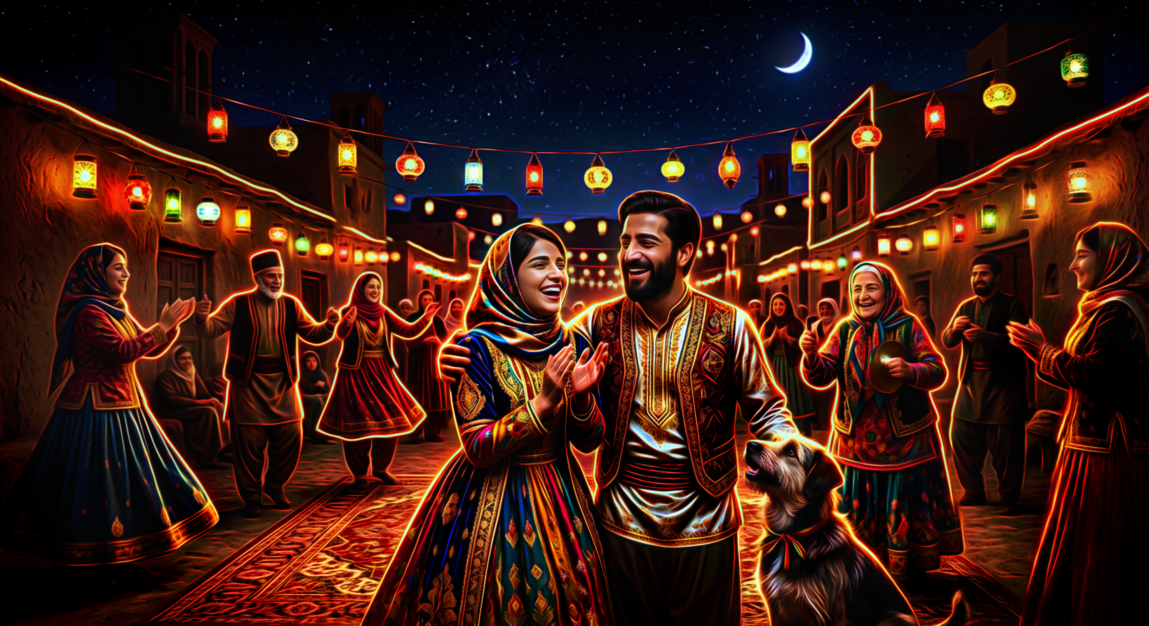
Just when you think you know a grandmother inside and out, you should prepare yourself for a surprise. The old lady, who only a few weeks ago had lain so fragile against her pillows, had secretly involved the entire village in a festive "conspiracy".
Nima and Sahar had absolutely no idea. As they stepped out into the street on the evening before their departure, they literally lost the ground beneath their feet—for the narrow alleys were completely lined with magnificent red Persian carpets. Above them stretched a sea of colorful lanterns, bathing the night sky in a warm, celebratory glow.
It was a farewell gift so brimming with the pure joy of life that tears of emotion welled up in their eyes.
Over the past few weeks, Grandmother had visibly gained weight and strength; she radiated an irrepressible energy tonight as she clapped joyfully, encouraging the entire village community to join the dance. Everyone took part in the celebration.
Sahar clapped enthusiastically, her colorful dress swirling to the rhythm of the music, while Nima laughed, wrapping his arm around her shoulder.
Even faithful Barto had dressed up for the occasion, sitting as proud as a little king amidst the excitement, his gaze fixed upward so as not to miss a single moment of the joy. It had been a wonderful, unforgettable time with Grandmother, a month in which the family had grown closer than ever before.
Yet, while the music played and the crescent moon hung gently over the mud-brick houses, a joyful, adventurous tension mingled with the laughter of the celebrating crowd. When the next morning dawned, it would be time to say goodbye. The journey was far from over; in fact, it was only now gathering real momentum.
Hidden away in their luggage was Martha's mysterious map, which Emil Gruber had entrusted to them on the deck of the ship.
Tomorrow, they would finally set out in search of the hidden cave on Qeshm Island. But tonight, the only things that mattered were the dance, the light, and the priceless fortune of being alive.
Chapter 17: The Glow of Eternity
Why the world's greatest treasure needs no chest, and Martha's secret shows us the way home.
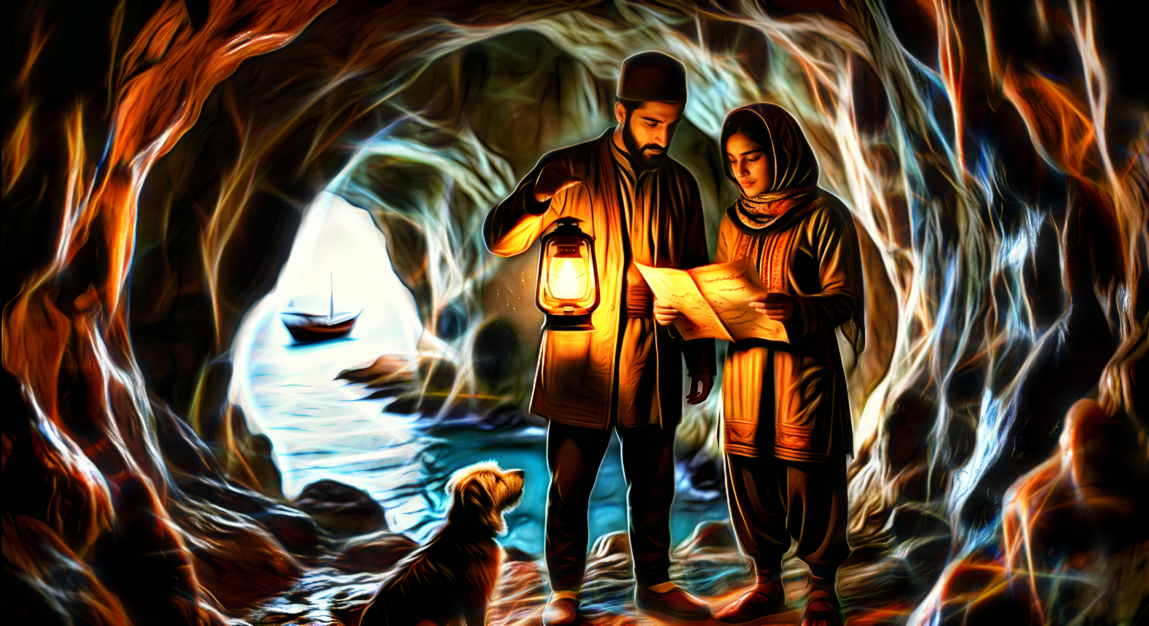
There are journeys one undertakes to find a destination—and in the end, one fulfills the legacy of a great soul. There we stood, deep within the rugged belly of Qeshm Island. Behind us, framed by the bright arch of the cave's entrance, lay the calm sea where our boat gently rode at anchor.
Before us rose the massive, ancient rock formations of the cavern. Nima raised the burning lantern, and at that exact moment, Sahar unfolded the map with trembling hands. A quick comparison, a disbelieving glance, and then absolute certainty: we had truly found Martha's cave. This was the place Martha had dreamed of her entire life, yet had never been permitted to see with her own eyes.
But anyone expecting cliché pirate treasures or heavy chests of gold completely misunderstood the true wonder of this place. As the bright daylight from outside struck the waves, refracting at a perfect angle and hitting the damp, mineral-rich cave walls, the entire cavern began to pulse magically. The fine moisture of the sea lay over the stone like a reflective film.
Suddenly, every crevice and every contour began to glow in shimmering hues of pure gold and warm orange, as if the rock itself were burning from within. Martha had spent years researching, reading countless texts about this natural phenomenon, which was likely entirely unique in the world.
It was precisely this magical play of light that she had wanted so desperately to see with her own eyes. We were seeing it now, for her.
At our feet sat Barto, looking up at us with infinite loyalty, his tail wagging gently. He needed no explanations to know that we had arrived.
Grandmother had been loved back to health, home remained preserved in our hearts, and Martha's lifelong dream had been fulfilled.
As Nima and Sahar softly rolled up the map, they understood the true message this journey had gifted them—a message they would carry as a compass home for the rest of their lives: Darkness is only the absence of light—be the light. Our journey had reached its end, but this eternal glow would burn within us forever.
Get all the images from the story in a free 4K download now!
Enter your email address below to secure the complete image package (without text) for free and download it instantly.